
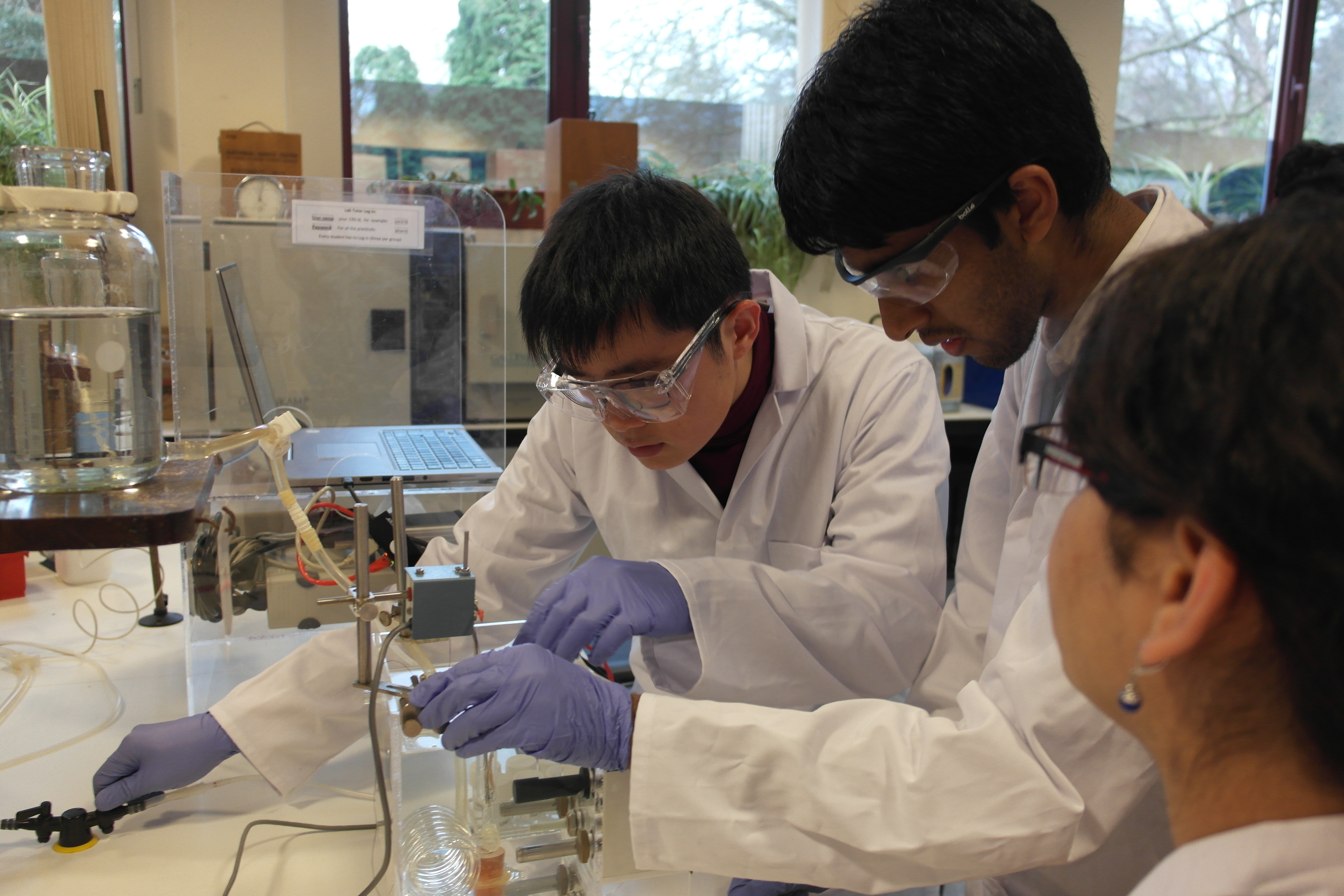

Help us to understand the action of drugs on the body and develop better treatments for disorders such as arthritis, diabetes, Crohn's, cardiovascular disease and cancer!
The Department of Pharmacology is at the forefront of research into the effects of drugs and other molecules on biological systems. This is a crucial first step towards a greater understanding of disease and eventual effective treatment.
The Department is actively seeking support for all aspects of its activities. With a donation, you will be supporting:
- The purchase of new equipment
- Research grants and collaborations around the UK and overseas
- The next generation of Cambridge pharmacologists via postgraduate studentships and undergraduate summer projects
- Student hardship funds
We would greatly appreciate any donations received, regardless of size.
If you would like to discuss how you might contribute to the Department, please contact the Head of Department or the Departmental Administrator. They will be very happy to discuss your concerns confidentially.
How you can help
£500 will contribute to enabling a researcher to publish their work in the best open-access journals. This level will also provide support for the travel costs for a researcher to visit a collaborator's laboratory or attend a conference within the UK. For international visits, £1000 would be a major contribution to costs.
£750 will provide support towards the travel costs for a researcher to visit a collaborator's laboratory or attend a conference.
£750 will enable a pharmacologist to develop an aspect of their research as an outreach project, for example, as part of the Young Pharmas programme.
£1,000 will support a postgraduate student for one month to extend or complete an exceptionally promising piece of research. £1,000 can also help a researcher visit a collaborator’s laboratory overseas.
£15,000 will help to provide part-time support for 6 months for a ‘Roving Researcher’ in a lab where a researcher is on leave (e.g. maternity leave, sick leave).
£20,000 will help towards the purchase of equipment for a new research group in the Department.
Donations can be made through the University's CUDAR website here.
Ways Travel Funds Have Helped Our Students
Sampurna Chakrabarti (Smith Lab, PhD student) visited Professor Paul Heppenstall’s laboratory at the European Molecular Biology Laboratory, Rome, to make adeno-associated viruses (AAVs) encoding cargoes that enabled chemical-genetic control of sensory neurons. Without access to a viral core facility, progress would have stopped. This funding allowed Sampurna to access this viral resource abroad. Sampurna used the AAVs to demonstrate how inhibiting the activity of knee-innervating sensory neurons could ameliorate joint pain.
Jess Berry (Harper Lab, PhD student) visited Professor Keith Neeves' lab at the University of Colorado, learning how to manufacture microfluidic devices that can replace animal experiments. Jess used this to develop an arterial thrombosis-on-a-chip device. Multiple projects in the lab are now using this technology to help secure further funding from the British Heart Foundation and the Medical Research Council.
Members of the Itzhaki Lab have visited collaborators in the UK, Europe, and Asia. Without financial support, these visits would have been impossible. These visits resulted in various publications, which include an exploration of the mechanical properties of proteins with the aim of developing sensor to understand mechanobiology and using an innovative peptide library to screen for inhibitors to target malaria.
Regarding summer students, a recent intern in the Miller Lab stated, “My summer placement was a fantastic experience that was pivotal in helping me decide if laboratory research was for me. Not only this, it also equipped me with skills and training, both technical and transferable, that opened doors and enabled me to subsequently make competitive PhD applications."